

Organized Chaos? Or is it?
Why It Happens and How to Get Ahead of It
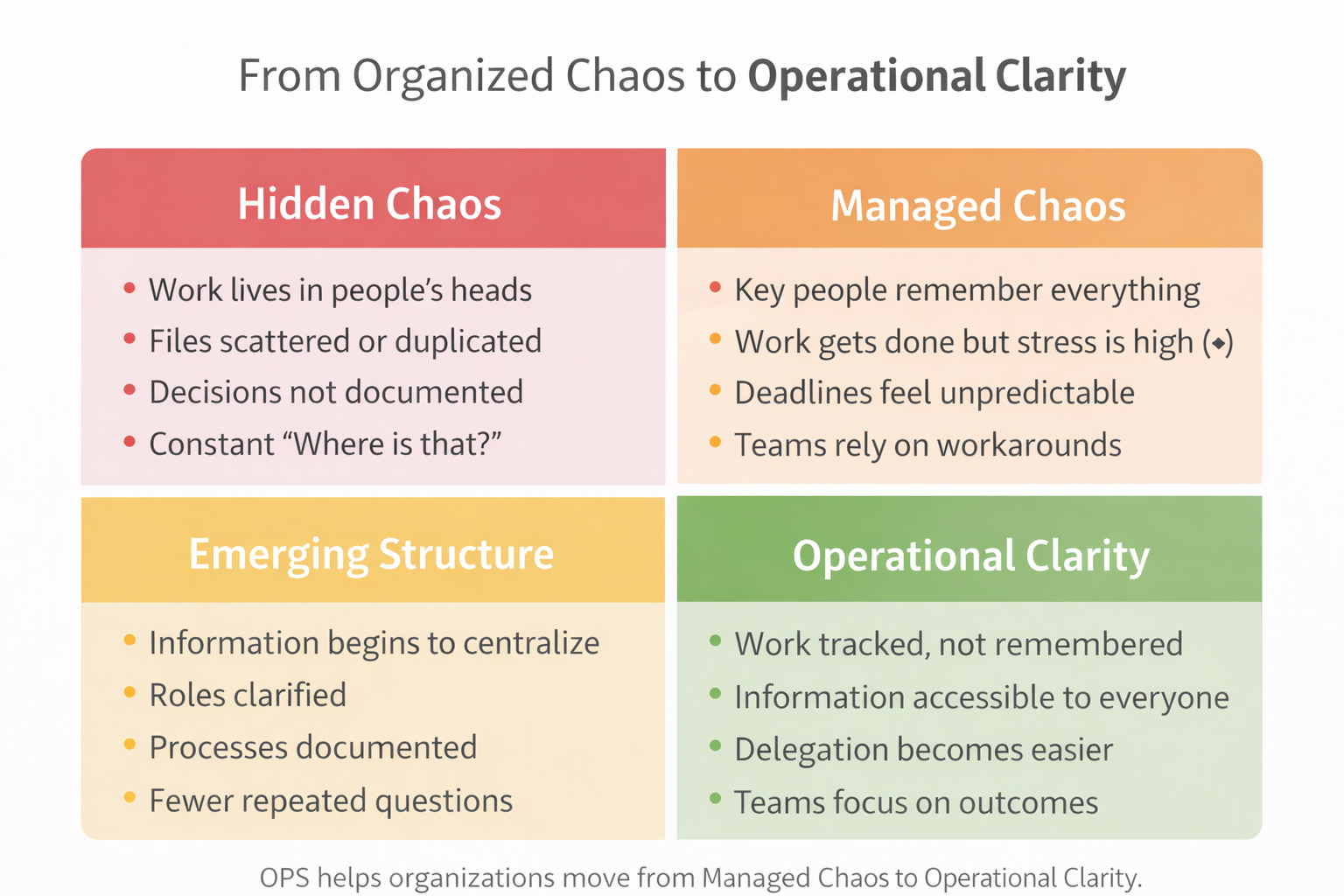
Many teams describe their work environment as organized chaos. It’s often said with pride — a sign that people are busy, adaptable, and handling a lot at once. But organized chaos isn’t actually a system. It’s a coping strategy. It usually means the work exists, the people are capable, and the goals are clear — but the structure underneath hasn’t caught up yet. Instead of relying on a consistent process, the organization relies on memory, familiarity, and individual effort to keep things moving. That works for a while.
Until it doesn’t.
What Organized Chaos Really Looks Like
Organized chaos doesn’t always feel chaotic at first. It often looks like:
Everyone knows “roughly” where things are
One or two people keep everything in their heads
Teams recreate files instead of locating them
Questions repeat because answers aren’t stored
Deadlines depend on reminders instead of tracking
Meetings revisit decisions already made
Nothing feels broken. But nothing feels stable either. The organization is functioning — but only because people are compensating for the gaps.
Why Businesses Wait Until Chaos Becomes a Problem
Most teams don’t ignore structure intentionally. They wait because the signals of chaos are subtle.
Chaos builds gradually.
It doesn’t show up as failure at first — it shows up as “we’re just busy.”
Familiarity feels like control.
If someone knows how to navigate the mess, it feels manageable. But that’s not control — that’s adaptation.
Prevention doesn’t belong to anyone.
Tracking, documenting, and structuring processes often fall outside formal job roles, so they get postponed until something breaks.
Fixing structure feels like extra work.
When things are still functioning, pausing to organize can feel inefficient — until the cost of reacting becomes higher than the cost of preparing.
The Real Risk of Organized Chaos
The biggest risk isn’t that things fall apart overnight. The real risk is dependency. If a system only works because certain people remember everything, the organization becomes fragile. When those people are unavailable — or simply overwhelmed — progress slows, errors increase, and stress rises across the team. That’s when organizations realize the chaos wasn’t organized at all. It was just being held together.
Seeing Chaos Before It Escalates
Most operational issues give early signals. You can see them when:
Work stalls when one person is out
Teams rely on email threads to reconstruct decisions
Staff feel constantly busy but outcomes are unclear
Deadlines feel urgent but not predictable
People hesitate to delegate because information isn’t centralized
These are not performance problems. They are structural ones.
How OPS Helps
Operational Productivity Solutions focuses on this earlier stage — the moment when things are still functioning but starting to strain. The goal isn’t to impose complicated systems or disrupt what’s working. It’s to identify where information, responsibilities, and workflows can be clarified so the organization runs on structure instead of memory. When that happens, teams spend less time reacting and more time moving forward with confidence. Because the most productive organizations aren’t the ones that manage chaos well.
They’re the ones that don’t have to.
